

Circa: Queer Histories Festival · Presented by One Institute
Cooper Do-nuts: A Living Archive of Los Angeles After Dark
Monday, October 26, 2026 · 8:00–9:30 PM Pacific
Online · Free · All ages
Can’t make it live? Register anyway and we’ll send you what we can afterward.
What we’re presenting
For sixty years, Cooper Do-nuts has come down to a single disputed night in May 1959. We think the history around that night is the more interesting one — and after seven years in city files, newspaper morgues and family closets, we have a great deal of it.
Over ninety minutes, Jacquie and Keith Evans will walk through what the documentary record actually holds, what it doesn’t, and why we say so either way.
Forty-six documented locations across California — most of which have never appeared on any public list.
A production bakery on East 6th Street, ovens in the back and a counter in the front, sending trucks out across the city at three in the morning.
A shop on West 6th that shared a wall with a gay bar — corroborated by a 1965 travel guide, our own location records, and a television crew that was filming something else entirely.
Nancy Valverde, arrested dozens of times for wearing pants, who told us she spent her money at Cooper’s because it was the one place she was welcomed rather than tolerated.
And the questions still open. We will be explicit about those too.
A preview
Before the parking lot
A photograph taken on January 3, 1958 shows the building where Cooper Do-nuts began — sixteen months before the night everyone argues about, and not long before the whole thing came down.
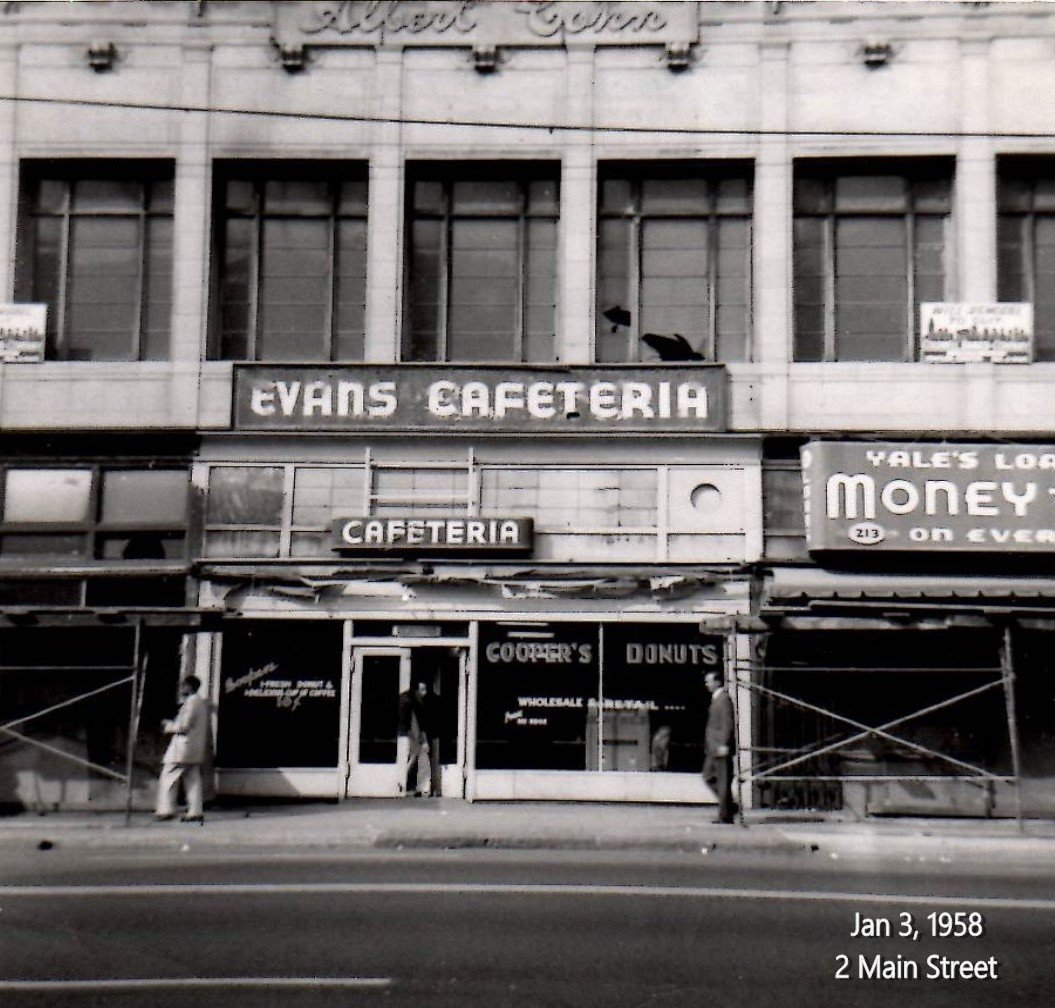
Read the glass and you get the whole business at once. EVANS CAFETERIA on the sign above the awning. COOPER’S DONUTS — WHOLESALE & RETAIL lettered across the window beneath it. On the left pane, smaller: a fresh donut and a delicious cup of coffee, ten cents. Next door, Yale’s Loan is lending money on everything. Scaffolding braces the frame at both ends.
Three people are on that sidewalk. Nobody wrote down a single name.
The cafeteria came first
Jack Evans grew up on a farm outside Chicago and came to California during the Depression. He worked his way through kitchens — hired, fired, hired again — until he knew the business from the inside.
In 1937, a labor dispute pushed Herbert M. Wilcox to sell off several of his downtown cafeterias. Jack bought one and put his own name on it: Evans Cafeteria. His brother-in-law Lou Fewster bought another and opened Fewster Cafeteria on East 5th. The Los Angeles Times carried the first Evans Cafeteria that September; it recorded the Fewster purchase in December 1941.
Somewhere in those years Jack met Richard Cooper, who had noticed what donuts were doing and proposed putting them on the counter at Evans Cafeteria. They sold. They kept selling. By the family’s account, Jack worked out that the donuts were moving off the shelf faster than anything else on the menu, and at half the effort.
Then the city handed down a mandate for building improvements. Jack made his decision: he bought out Richard Cooper’s share for fifty thousand dollars and went all in on donuts. The family remembers Cooper — a gambler, by their telling — asking whether he could cash the check. Jack told him he could cash it any time he wanted. Cooper walked to the bank that same day.
What happened to the building
The building in the photograph came down. The lot became parking. And on the corner of that lot, at 213 South Main Street, one of the first prefab Cooper Do-nuts went up — a counter, a roof, and a sign, built in the corner of the parking lot that had replaced the cafeteria.
What the chain became is easier to count. Forty-six locations documented across California, from downtown to Pacoima to Stockton. Trucks going out across the city before dawn. A business that stayed open until 1995.
The cafeteria is gone, the lot is gone, and a street sign stands at the corner now. The photograph is most of what is left of the building itself.
And the night in 1959
The Cooper Do-nuts that stood on this lot is the shop most often named in accounts of what is said to have happened in May 1959 — a confrontation between Los Angeles police and queer and trans customers at a Cooper Do-nuts counter, told and retold for sixty years as a landmark of LGBTQ+ resistance.
We cannot confirm it, and we have never said otherwise. There is no contemporaneous newspaper account. There is no police report. John Rechy, whose telling put the story into circulation, has himself said more than once that the shop was not a Cooper’s. What we can tell you is what the record holds and what it does not, which is what we spend our time on.
What is not in dispute is the rest of it. Nancy Valverde was arrested dozens of times for wearing pants, the first time at seventeen, walking to barber school on this same street. She told us she spent her money at Cooper’s because it was the one place she was welcomed rather than tolerated. That is a first-hand account from a named person about a documented business, and it does not depend on 1959 at all.
This photograph was taken sixteen months before that May. Whatever did or did not happen on this street, the counter in that window was already there, already open, already selling coffee and a donut for a dime to whoever walked in.
Monday, October 26
We’re presenting all of it.
8:00–9:30 PM Pacific · Online · Free · All ages
Part of Circa: Queer Histories Festival, presented by One Institute.
One more thing
The archive isn’t finished.
Fourteen of the locations we have documented are in Northern California — Stockton, Sacramento, Carmichael — and almost nothing about them was ever written down. The people who worked those counters are the only record left.
If you have photographs, menus, uniforms or memories of a Cooper Do-nuts anywhere in the state, or you knew someone who worked at one, we would like to hear from you. Nothing is published without your permission.
Some of you already have. We kept every one of them, we have read them more times than you would guess, and several turn up in what we’re presenting on the 26th.
Share a memory →